
Battery cable is sized on continuous current, but the current that matters is the one inside a closed container at 40 °C ambient, with six cables in a bundle and a duty cycle that never fully rests.
An energy storage system charges and discharges continuously. The cable current is bidirectional, the conductor temperature cycles with it, and the terminations see the same swing. Sizing on a steady-state current alone understates the thermal duty.
Take the maximum continuous current from the PCS or rack datasheet, then apply the enclosure ambient and the grouping factor. A cable rated 105 °C in free air is not rated 105 °C in a closed container with five neighbours. Construction and current data for the rack connection are on the energy storage battery cable page.
Apply the factors to the tabulated current, then check that the resulting section still satisfies the voltage drop limit for the run length.
At 1500 V DC the percentage drop for a given current and section is smaller than at low voltage, but the runs inside a large BESS can still be tens of metres between rack and PCS. A 1 % drop at 1500 V is 15 V, which is usually acceptable; a 3 % drop is a design problem and a heat problem at the same time.
Where two cables are paralleled, they must be the same length, the same construction and the same route. Mismatched lengths share current unevenly and one cable runs hotter than the calculation.
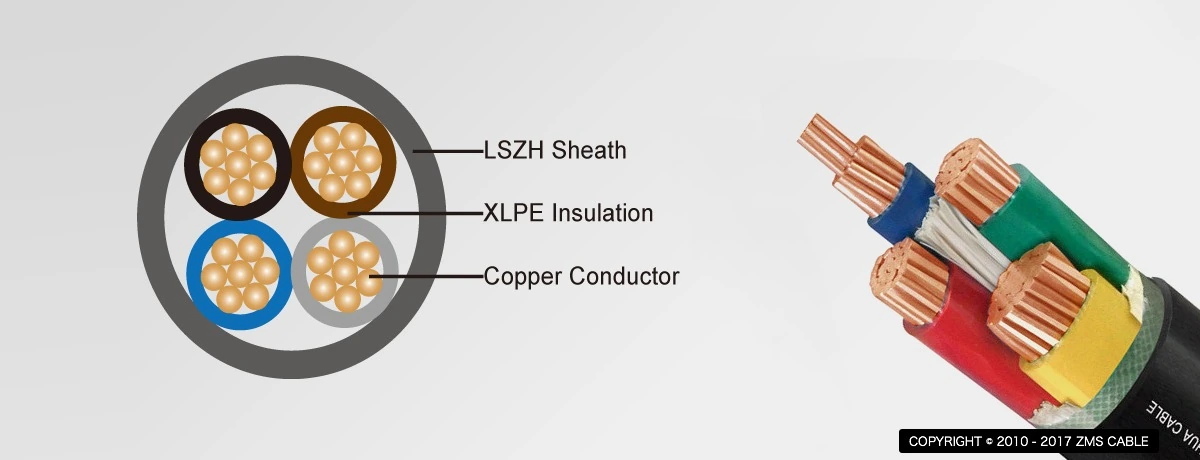
Specify the voltage rating, the conductor class (Class 6 for tight rack dressing), the sheath (LSZH in a container), the temperature rating and the fire performance. Ask for the current rating table, the derating factors and the conductor resistance for the section you are buying.
If the rack layout is fixed, ask for cut lengths with lugs and heat-shrink fitted. It removes a field termination step and a common source of hot joints. BMS and EMS communication links are covered by the energy storage monitoring cable, and the full DC-side range is under energy storage cables.
1500 V DC, Class 6 tinned copper, XLPO insulation, LSZH sheath, EN 50618.
View ProductSend the plant data and we will confirm the construction, the standard and the delivery schedule.
Share the system voltage, conductor size, cable length, installation route, sheath or armour requirement and delivery destination. Our engineering team will reply within one business day.