
The MV collector is the part of a PV plant where a cable mistake is expensive to correct: long runs, high fault levels and joints that have to survive 25 years in a trench. This note covers the four decisions that set the construction.
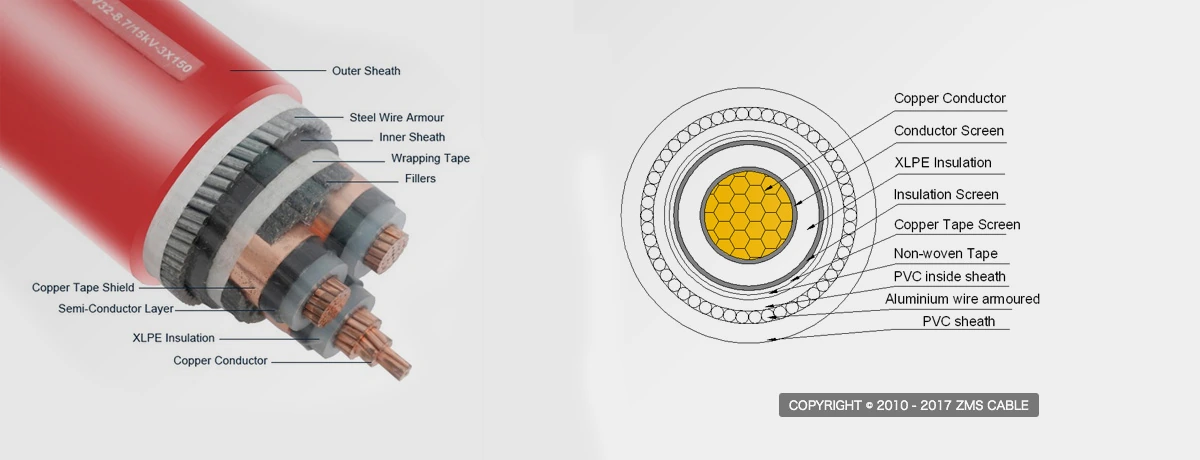
A collector feeder is sized twice: once for the continuous current of the strings it gathers, and once for the short-circuit current the network can deliver. The second check usually decides the screen and the armour, because the metallic screen has to carry the fault current for the clearing time without overheating the insulation.
Ask the network operator for the fault level and the clearing time before the cable is ordered. A feeder that looks generous on current can still be undersized on screen.
Copper is the default for shorter runs and for joints that have to be made in the field. Aluminium is cheaper per ampere on long runs but needs compression terminals, bimetallic lugs and more careful bending radius. On a 33 kV feeder of several kilometres the saving is real; on a 6 kV run inside the plant it is usually not worth the extra termination discipline.
The 6–35 kV MV collector cable is supplied in both conductors with the same XLPE insulation and wire screen construction.
A copper wire screen carries the earth-fault current; the armour protects against mechanical damage during backfill and later excavation. For direct burial in rocky ground, steel tape or wire armour is normal; for installation in ducts, an unarmoured construction with a thick oversheath is often enough.
Where several feeders share a trench, spacing and the resulting derating have to be agreed with the installation contractor early. Moving a feeder later because the grouping was ignored is a costly change.
Most MV failures start at a joint. Specify the jointing kit together with the cable, from the same manufacturer where possible, and require the jointing team to be certified for that kit. For a plant with hundreds of joints, a pre-moulded or cold-shrink system is faster and more repeatable than tape.
The new energy collector cable range page lists the screen and armour options that are kept in stock for project schedules.
Send the system voltage, the fault level and clearing time, the route length, the installation method (trench, duct, tray), the expected ambient and soil temperature, and the joint positions if they are already fixed. With those five points a construction can be confirmed and quoted without a second round of questions.
6–35 kV XLPE, copper or aluminium conductor, wire screen and armour to IEC 60502-2.
View ProductSend the plant data and we will confirm the construction, the standard and the delivery schedule.
Share the system voltage, conductor size, cable length, installation route, sheath or armour requirement and delivery destination. Our engineering team will reply within one business day.